Gifting Platform Reporting for Proving Pipeline Attribution to Finance
Map gifting touchpoints to revenue events in your CRM to prove pipeline impact to finance.

Finance doesn't say no to gifting because gifting fails to produce results. Finance says no when the reporting behind the request can't survive a follow-up question, and that gap in the reporting is what produces the rejection. That distinction explains most of the budget conversations gifting teams lose, and it's the thread this piece follows from end to end.
Why finance rejects gifting budget requests
Picture the quarterly business review. The gifting team presents a number: a large chunk of pipeline, "influenced" by a recent campaign. The CFO asks one question: how was that number calculated? The honest answer involves a spreadsheet, a gut feeling about which deals "probably" got a boost, and no clean way to trace any of it back to a logged event, and that's the moment the budget request dies.
Gifting programs are good at producing activity data. Redemption rates. Send volumes. Open rates on the notification email. These numbers are genuinely useful for a gift manager trying to decide whether a wine selection landed better than a tech gadget, or whether Tuesday sends outperform Thursday sends. But none of that is revenue data, and finance doesn't evaluate budget requests on activity. A redemption rate tells a gift manager whether the selection resonated. It says nothing to a CFO about whether the quarter's pipeline target gets hit.
The damage compounds the second time around. A team that once claimed gifting "influenced" a large pipeline number, without being able to walk through the methodology when asked, doesn't get a neutral hearing at the next budget cycle. Finance remembers inflated numbers longer than it remembers accurate ones. It's a data infrastructure problem, and infrastructure is fixable in a way that a finance team's trust, once spent, is not easily rebuilt.
The two types of revenue credit gifting can legitimately claim
Before any dashboard gets built or any model gets chosen, a gifting team needs to settle what it's actually allowed to claim. Get this wrong and every number downstream inherits the error. Two categories exist, and conflating them is the single most common way gifting programs lose credibility.
Sourced revenue means gifting was the first meaningful touchpoint, the thing that created a net-new opportunity where nothing existed before. This happens, but it's rare. It typically occurs in cold prospecting, where a gift is the opener itself, with no prior email thread or call history to compete for credit. If a sales rep had never spoken to the contact before the gift arrived and a meeting gets booked afterward, that's a clean sourced claim.
Influenced revenue is where most gifting programs actually live. A gift touches an opportunity somewhere in its life cycle and correlates with a positive outcome: a faster close, a larger deal, a meeting that finally gets booked after a sequence had gone cold. That's a real contribution, but it's a different claim than sourcing, and it needs to be reported as one.
The error that ends programs is counting every opportunity that had any gift touchpoint, at any stage, as fully influenced. That inflates pipeline contribution past what any audit will tolerate, and the first time someone checks the math, the number collapses. Define "influenced" in writing before reporting anything. Otherwise it means whatever is convenient in the moment, and finance notices that pattern fast.
CRM logging as the foundation of gift attribution
Every attribution claim gifting makes rests on one condition: was the send logged in the CRM, against the contact record and the opportunity record, before the campaign ran? What follows is reconstruction from memory, assembled after the fact, and reconstruction doesn't hold up when finance asks for the source.
The logging itself needs specifics. Every gift event that matters for attribution should carry a timestamp: send date, gift type, campaign name, and a custom field that makes filtered reporting possible later. A platform that only pushes data one direction, or that requires a CSV export to reconcile what actually happened, makes clean attribution nearly impossible once a program scales past a handful of campaigns. The integration needs to run both ways and run automatically, or the data entry becomes a part-time job nobody has time for.
Timing matters as much as the fields themselves. Contacts should get tagged in the CRM before the drop, not after. Retrofitting attribution onto a list that's already been mailed is guesswork dressed up as analysis, and the specific sequence that proves causation, gift sent before meeting booked rather than the reverse, disappears once the tagging happens late.
Attribution windows need the same discipline. A 30-day measurement window might work for a paid social campaign, but gifting usually operates inside a sales cycle that runs three to twelve months. A 30-day window applied to that kind of cycle will call a working campaign a failure, simply because the deal hadn't closed yet when the window closed.
None of this works in isolation. Gift touchpoints need to map against the revenue-side events that already live in the CRM the sales leader trusts: meeting booked, stage advancement, opportunity created, closed-won. Those events are the anchor. Gifting data only becomes meaningful once it's tied to them.
Which attribution model survives a CFO review
With logging in place, the next question is which rule assigns credit. Gifting teams are picking from the same attribution toolbox the rest of marketing already uses, and that familiarity is an advantage in the room.
First-touch attribution overcredits gifting in most programs, because gifting usually functions as an accelerator in the middle of a deal, not the opener that starts it. Claiming first-touch credit for a channel that mostly shows up mid-cycle inflates the sourced-revenue number past what the data supports, and that's exactly the kind of overclaim that gets challenged.
Multi-touch models with an explicit, stated percentage of credit hold up better, because they give finance something to audit. A gifting team that states a specific share of deal value, for a channel that wasn't the primary driver, is making a claim that can be checked and either confirmed or corrected, which is what makes it credible: it can be wrong in a visible way.
The structure that lands hardest in a CFO review is the controlled cohort. Split a target account list into two groups, matched on firmographics and deal stage: one gets gifting, one doesn't. Then compare meeting rate, deal velocity, win rate, and average deal size between the two groups. The gap between them is the argument. It's a measured difference between two groups that started from the same place.
That comparison isn't flawless. A cohort split is observational, so it leaves some confounding variables unruled-out. But it offers something closer to causal evidence than a single influenced-pipeline figure ever will, and it mirrors the kind of A/B thinking finance already uses to evaluate everything else in the revenue stack. That familiarity is what gets it taken seriously.
The leading indicators that tell you a campaign is working before closed-won data arrives
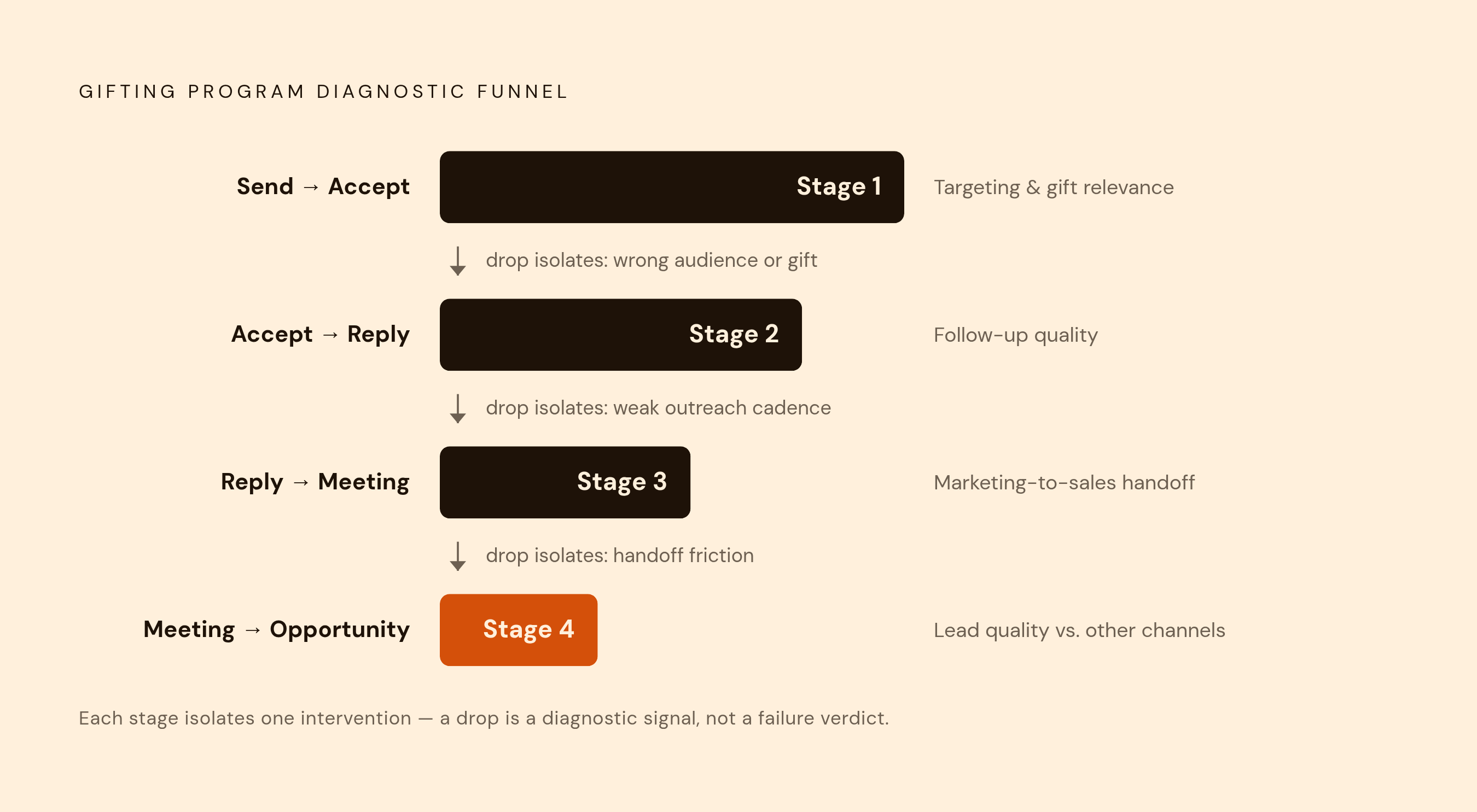
Closed-won revenue can take months to appear after a gift goes out, and a gifting team that waits for that number before reporting anything is flying blind in the meantime. A funnel of leading indicators fills that gap, with each one doing a specific diagnostic job.
Send-to-accept rate answers a targeting question: is the gift reaching the right person, and does it resonate enough to get claimed? A weak number here points at list quality or gift relevance, not messaging.
Accept-to-reply rate answers a different question: does the gift actually start a conversation, or do recipients take it and go quiet? A gift that gets accepted but produces silence is a follow-up problem, not a selection problem.
Reply-to-meeting rate checks whether the conversation is converting into something sales can work. A conversation that never turns into a booked meeting breaks down somewhere in the handoff between marketing and sales.
Meeting-to-opportunity rate checks quality: are gifted meetings qualifying into real opportunities at the same rate as meetings sourced from other channels, or better?
Reading these together is the point. A strong send-to-accept rate paired with a weak accept-to-reply rate means the gift selection is working but the follow-up, timing or message, is off. That's a coaching fix for sales, not a reason to change the gift catalog. A weak send-to-accept rate from the start is a different problem entirely: targeting or gift relevance, and no amount of follow-up discipline fixes that. Each stage in the funnel tells the team exactly where to intervene, weeks before a single closed-won deal confirms or denies the campaign.
The full cost stack finance will look for, and most gifting teams leave out
Revenue isn't the only number finance scrutinizes. The cost side gets checked just as hard, and most gifting teams calculate ROI using gift spend alone, which produces a number that looks good right up until someone audits it. Getting the full cost stack on the table first, before finance asks for it, is what makes the ROI claim trustworthy.
The full stack includes gift unit cost with customization, fulfillment and shipping including international duties, platform or vendor subscription fees, admin time for sourcing and coordinating and tracking sends (converted to dollars at the sender's fully-loaded hourly rate), and waste from undelivered sends, including packages returned for bad addresses.
Admin time is the cost most teams miss completely. Hours spent manually coordinating a send across a dozen tools don't appear on an invoice, but they're real labor cost, and leaving them out understates the true price of running the program. A purpose-built sending platform earns its keep here: it automates that coordination work, and the time saved is a measurable benefit that belongs on the other side of the ledger.
Undelivered sends do double duty on the damage they cause. They're a straightforward cost: gift purchased, shipping paid, no outcome to show for it. They're also an attribution distortion, because a gift that never arrived couldn't have influenced anything downstream. Those sends need to come out of the attribution numerator the same way they get counted in the cost denominator, or the ROI number is wrong in two directions at once.
A conservative number that finance can audit and confirm is worth more than an optimistic one that gets challenged in the meeting. An ROI figure that survives scrutiny protects the next budget request. One that gets picked apart costs more than the program it was defending.
What a finance-ready gifting dashboard contains
Once the logging, the model, and the cost stack are in place, they need to come together in one view, built in the language finance already speaks elsewhere in the revenue stack. A dashboard translated at the last minute from engagement metrics doesn't do that job.
Total program spend should break down by component: gift spend, fulfillment, platform fees, admin time, each as its own line. Pipeline sourced should show new opportunity value where gifting was the first touch that triggered a response, with the campaign name and the CRM filter that produces the number both visible and checkable. Pipeline influenced should show deals already in motion where a gift touchpoint preceded a positive stage move, with the attribution methodology, model type, credit percentage, and measurement window stated in the body of the report. Response rate should compare gifted accounts against the non-gifted control cohort from the same campaign, not against a generic industry benchmark pulled from somewhere else. Deal velocity should show average days from gift send to closed-won for gifted accounts against the non-gifted cohort, the number that demonstrates acceleration.
Finance wants to hear one sentence, in effect: for every dollar spent, here's what came back, with the full cost acknowledged and a real campaign example showing the calculation worked through actual data. An abstract description of a methodology is a claim. A worked example from a real campaign is evidence, and evidence is what moves a room that's heard inflated numbers before. A dashboard finance can audit line by line is more persuasive than one it has to take on faith. Transparency is the strategy, not a concession.
Reporting retention and expansion gifting versus pipeline gifting
Pipeline is one place gifting shows up, but post-sale gifting, renewal protection, expansion, churn prevention, needs its own reporting frame. The outcome being measured is retained revenue and expansion, not new pipeline, and folding the two together produces a confused ROI number that satisfies no one.
The relevant metrics shift accordingly: renewal rate for gifted accounts compared against non-gifted accounts, expansion revenue from upsell and cross-sell among accounts that received gifting touchpoints, and churn rate measured by cohort. The comparison only holds up if gifted and non-gifted groups get tracked separately from the start of the program. Retroactive analysis introduces too many variables to produce a claim anyone can defend, which is the same infrastructure requirement pipeline attribution runs on.
The business case here is often easier to make than the pipeline case, for a simple reason: the cost of a lost account is already concrete and sitting in the CRM. A renewal gift sent to an at-risk account can be measured directly against the average churn cost per account, a comparison finance doesn't need much convincing to accept. Gifting tied to specific journey moments, post-onboarding, pre-renewal, after an escalation gets resolved, at an advocacy milestone, produces cleaner attribution than ambient relationship gifting sent with no particular trigger, because both the event and the outcome carry a timestamp finance can check.
Presenting gifting attribution in a QBR
Everything built in the sections above exists to be presented, and how it gets presented decides whether the work holds up under questioning. Lead with the cohort comparison, not the influenced-pipeline total. A gap between a gifted group and a matched non-gifted group is harder to argue with than a single aggregated number, because it comes with its own built-in comparison.
State the methodology before anyone asks for it. Name the attribution model, the credit percentage, the measurement window, out loud, in the room, before the first question lands. A team that volunteers its own limitations reads as more credible than one that waits to be caught.
Bring the cost stack into the same conversation as the revenue number. A CFO who sees admin time, fulfillment, and waste already accounted for has less reason to suspect the number underneath. Close with one real campaign, walked through end to end: spend, cohort, model, outcome. That single worked example does more to earn the next budget cycle than any slide full of averages, because it shows the team can trace a dollar from send to revenue and account for every step along the way.