Corporate Gift Sending Logistics for APAC Recipient Countries
A country-by-country guide to timing, customs, and compliance risks.

Corporate gift sending to APAC recipient countries starts with decisions about compliance, sourcing, and delivery. For B2B teams, the practical answer is a country-aware program designed backward from the arrival date. Before production begins, the plan must account for customs rules, who the recipients are, what their culture expects, and where local delivery is available.
Why APAC is a distinct logistics problem, not just a distant destination
A reliable domestic gifting program does not become an APAC program simply by adding international postage. The region spans megacities, island archipelagos, and remote inland areas, with different customs regimes and cultural rules between markets. Distance is only part of the problem. A carrier hand-off that works in a Tier 1 city may fail to reach a recipient in a secondary city or regional office.
That variation exposes the limits of a North American fulfillment model extended into APAC. Routing, restricted items, and documentation need to be built into the process from the start. What happens when the gift is acceptable but the address is outside reliable last-mile coverage? The team must choose the fulfillment route as it chooses the gift.
How lead times in APAC are structured and why they are routinely underestimated
A delivery estimate covers only part of the work. Before a parcel enters the carrier network, someone must approve the program, collect addresses, confirm stock, complete production and decoration, prepare localized inserts, and assemble customs data. These stages depend on inputs from earlier stages. An incomplete recipient file can hold up personalization, while an unsettled product choice prevents accurate customs preparation.
The Global Corporate Gifting Lead-Time Index 2026 separates this controllable work from external transit and gives different planning bands by fulfillment model. The index puts APAC local digital rewards at 1–4 business days and stocked branded merchandise from a local warehouse at 8–16 business days. Its APAC cross-border custom-production band is 30–60 business days. APAC is also not the region with the widest ranges in the index, which assigns that distinction to Latin America.
The index reserves the low end for stable scope, confirmed goods and capacity, complete data, and no peak-season or border exception. How often are all those conditions settled when a multi-country campaign is first proposed? The planning implication is to allow 8–12 weeks before delivery, with the full window for more involved programs. Time for contingency must be added beyond the upper end of the estimated work.
What customs paperwork failure actually looks like and how to prevent it
DHL’s customs guidance says delays often stem from wrong or missing data, unclear descriptions of goods, tariff-code errors, and undervaluation. Calling an item a gift does not remove the need to describe and value it properly. A zero declaration or “no commercial value” marking can trigger inspection, fines, and delay.
With Delivery Duty Unpaid, or DDU, the recipient has to pay taxes and fees when the gift arrives. That undermines the purpose of a corporate gift. Delivery Duty Paid, or DDP, is the appropriate format because the sender absorbs those costs before the parcel reaches the recipient. Where a Free Trade Agreement offers reduced duties, a Certificate of Origin provides the required proof of manufacture, and without it the benefit is forfeited.
These requirements make a knowledgeable logistics partner important for teams without in-country expertise. Rules can also change before internal processes catch up. FedEx’s 2026 APAC research found that just 59% of APAC businesses were fully or mostly prepared for the EU de minimis removal effective July 1, 2026. That change concerns APAC businesses shipping into Europe. Its relevance is the readiness gap, including limited actionable guidance, insufficient internal expertise, and difficulty keeping pace with changing requirements.
Country-level rules for China, Japan, South Korea, India, Singapore, and Indonesia
China requires both recipient compliance review and careful product screening. Changes to China’s Anti-Unfair Competition Law took effect in October 2025, raising the maximum fine for commercial bribery and making the managers responsible personally liable. An April 2026 judicial interpretation brought the standards for criminal liability for private-sector bribery into line with those for public-sector corruption. Food imports require particular care as well. Strict rules make perishables and consumables a significant customs-rejection risk, so selection cannot be separated from import review.
Japan combines import requirements with strong expectations about presentation. Before shipping tech gadgets and electronics, teams must check that they meet Japanese technical standards, and missing details about item names, quantities, or prices can hold up mail clearance. Packaging is part of the gift itself. Seasonal business gifting centers on ochugen in summer and oseibo at year-end, with preserved foods and quality household items among appropriate choices. Sets of four are avoided because the number is associated with death, and poor wrapping can signal disrespect regardless of the contents.
South Korea requires recipient status to be established before gift value is set. The statutory gift cap for public officials is approximately $45, making assumptions based on a standard US send unreliable. Private-sector status is not a blanket exemption. The Clifford Chance Asia-Pacific Anti-Corruption Guide identifies private-sector bribery as expressly criminalized, so recipient review is necessary beyond government accounts.
India assesses gift import duties against declared value, and undervaluation can trigger inspection. Food and consumables also face category-specific import restrictions. Teams also need to check whether delivery is possible at each address. Last-mile delivery quality differs widely between destinations in and outside metropolitan areas, especially in Tier 2 and Tier 3 cities.
Singapore expressly criminalizes private-sector bribery, and the Clifford Chance guide lists no de minimis threshold. A small gift is not automatically safe. Potential liability depends on whether it can be construed as an inducement, while expectations around quality and packaging make low-cost promotional items a poor fit. Singapore’s developed logistics infrastructure supports its role as a regional distribution hub. Hong Kong shares that hub role and the absence of a de minimis threshold, although promotional items of insignificant value are generally permitted exceptions under its law.
Indonesia treats gifts and hospitality to public officials as “gratuity,” creating obligations for the recipient. Reporting is required to the agency’s Gratuity Control Unit within 7–10 working days, depending on the agency, and to the KPK, or Corruption Eradication Commission, within 30 working days. Intent does not remove that reporting process. Gifting remains subject to restrictions despite the Clifford Chance guide’s omission of private-sector bribery as expressly criminalized in Indonesia. Island geography also makes carrier selection and routing consequential across the archipelago.
These profiles rule out an unfiltered regional catalog. Even a pre-approved item needs to pass checks for the country before the team can approve sending it.
Why gift selection cannot happen before country and recipient compliance checks
The workable sequence starts with the recipient’s country and role, then moves through anti-bribery limits, prohibited categories, and cultural screening. Only after those checks can the team set a compliant value limit and choose a gift. Otherwise, a sourcing decision becomes a commitment that later checks may force the team to undo.
Does that front-loaded review slow the campaign down? It takes time, but it avoids spending production and logistics time on an unsuitable choice. An item acceptable for a private-sector contact in Singapore may create a disclosure obligation for a public official in another country or breach a public official’s value limit elsewhere. Materials, colors, numbers, and symbolism can further narrow the options. Reviewing these constraints before purchase is faster than recovering from a confiscated shipment or a legal incident after dispatch.
Local sourcing and regional warehousing as the answer to cross-border lead-time and customs risk
Sourcing within the destination country removes export controls, international transit, and import clearance from that gift’s delivery path. This changes the structure of the work. A locally purchased consumable does not face the import restrictions that could block the same category of product at the border. The index likewise distinguishes locally sourced ready gifts from the substantially longer cross-border custom-production model.
Singapore and Hong Kong can serve as staging points for broader APAC campaigns, capturing some cross-border savings and reducing customs clearance events. A regional hub is not the destination country, however. Gifts moving onward across a border still need destination-specific customs planning, so regional fulfillment should not be confused with a fully domestic send.
To source gifts locally, teams need suppliers they can work with and a way to manage stock, so many turn to a partner who knows how to do both. The objection is often the unit price. A local item can cost more than one bought in a bulk cross-border order, but the comparison must also include re-shipping, customs penalties, and a missed relationship-building touchpoint.
How AI tools reduce the per-recipient compliance and personalization burden across APAC markets
When teams check every send against the rules for its country, the work done by hand can grow quickly in a program that spans several markets. AI-powered gifting tools can move screening into a pre-send layer, flagging gifts that exceed country-specific anti-bribery limits or fall into restricted categories before an order is placed. Localized recommendations can then use role, company, location, and past engagement to suggest appropriate options from local or regional inventory. That reduces repetitive work for each recipient. It also keeps the recommendation connected to what can actually be fulfilled.
Address verification and routing tools address a separate constraint by checking deliverability where formats and coverage vary by country and city tier. Personalized message generation can create notes that fit the recipient’s local culture. The message needs the same care as the item. CRM and marketing automation integrations then connect send activity to pipeline data, reducing the attribution noise caused when delayed shipments live outside the data stack. These tools free up time for account strategy by reducing the screening and personalization work the team has to repeat by hand.
Building the APAC gifting program calendar: when to start and how to sequence the work
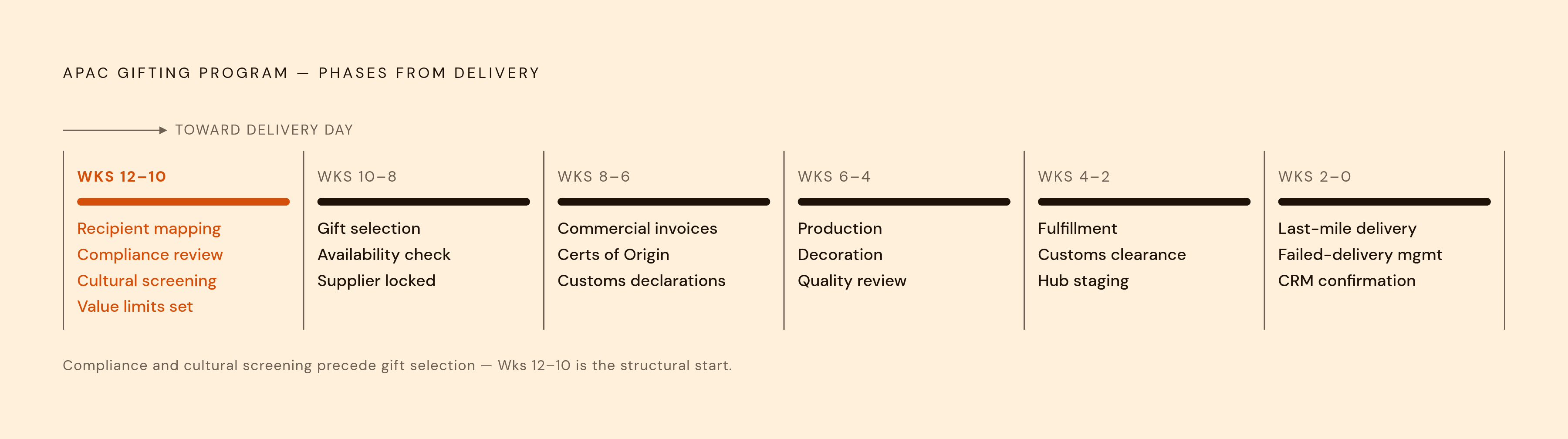
The planning calendar should run backward from the required arrival date. Programs with custom production, multiple countries, or restricted items should plan beyond eight weeks and use the full 12-week horizon. Before that calendar is finalized, the team should confirm the sending platform’s APAC address-verification capability and CRM integration. Otherwise, manual work remains hidden in the plan. A platform that cannot support deliverable addresses in Tier 2 cities or write send data back to Salesforce or HubSpot leaves operational gaps.
Weeks 12–10 belong to recipient mapping, country-level compliance review, cultural screening, and compliant value limits. Selection comes after those decisions are complete. During weeks 10–8, the team chooses gifts within those limits, confirms local or regional availability, and locks supplier capacity. Weeks 8–6 then cover commercial invoices, Certificates of Origin, and customs declarations where required. Recipient names, messages, variants, and delivery addresses must also be settled during that period.
Weeks 6–4 cover production, decoration, quality review, and packaging that meets cultural expectations. During weeks 4–2, work moves into fulfillment, labeling, carrier entry, customs clearance, and regional hub staging where applicable. Weeks 2–0 are reserved for last-mile delivery, management of failed deliveries or customs holds, and delivery confirmation back into the CRM. Each stage needs the preceding stage’s inputs to be ready.
The index’s contingency rule remains separate from these work allocations. The upper estimate is not spare time. Any required contingency must be added outside the planned range, and the plan is incomplete if compliance, sourcing, or documentation is still unresolved when production begins. That is the practical test of whether logistics has been treated as program strategy rather than an execution detail left until after the gift is chosen.