Corporate Gift Fulfillment Options for Recipients in India
Compare local vendors, eGifts, and cross-border shipping to pick the right route.

Corporate gift fulfillment for recipients in India works best when the delivery model is chosen before the gift. Local vendors, digital rewards, cross-border shipping, and platform-managed workflows each meet a different need. For global revenue teams, the choice turns on where recipients live, when the gift needs to arrive, and how the send connects to the program behind it.
Why sending corporate gifts to India is not like sending to any other market
Consider the failure that a standard global workflow can create. A global marketing team sends a physical gift from its US warehouse, but it sits in customs for two weeks. It arrives damaged, and the Diwali window has closed. The item may have been appropriate for the recipient, yet the fulfillment route defeated the purpose of sending it. What looked like a shipping decision was really a decision about whether the campaign could work.
India’s corporate gifting market is large and growing, but that does not make delivery uniform. Diwali concentrates a disproportionate share of annual volume, creating logistics pressure every October that tests even established vendors. Seasonal demand is only part of the difficulty. A supplier’s ability to offer gifts is different from its ability to issue GST invoices, track delivery service-level agreements, and integrate with enterprise systems. Global teams need those operational capabilities alongside an appealing catalog.
What makes cross-border shipping into India a poor default for most sends
India has no de minimis threshold for inbound commercial shipments, so even a single item in a mailer is subject to customs duty and tax on arrival. The person-to-person gift exemption of up to ₹5,000 declared value does not cleanly apply to company-to-employee shipments, which customs often classifies as commercial. A low-value gift’s customs treatment depends on its shipment classification as well as its price.
Timing is just as difficult to predict. A package may clear smoothly at one port and be held for weeks at another, with no reliable customs clearance SLA. For bulk swag produced overseas, the full sequence of production, kitting, customer approval, international transit, and customs clearance can run seven to eight weeks door-to-door. Lithium battery items, including power banks and wireless earbuds, face more import restrictions, so buying them locally is best.
Starting August 29, 2025, the US eliminated its de minimis exemption for packages from all countries, including India, requiring customs duties regardless of value. India’s April 2026 export reforms removed the ₹10 lakh value cap on commercial exports via courier and introduced a simplified mechanism for returning shipments to their point of origin. Those changes ease outbound shipping. For India recipients, local production solves the three central problems together by eliminating customs risk, compressing timelines, and usually lowering per-unit costs once duties and international shipping are included.
Local India-based vendors: what they cover and how they differ
Check what “pan-India delivery” means for the actual recipient list. Some vendors reliably reach Tier 1 cities within a few days, while others explicitly cover smaller cities such as Mysuru, Coimbatore, Nagpur, and Jaipur. Coverage needs to match the recipient map. A program serving remote employees has different requirements from one delivering all its kits to a metro office.
The vendors also differ in their automation tools. Swageazy offers gifting systems that sync with CRM and HR software, including HRMS integration that triggers a “Gift of Choice” link for every new hire. Xoxoday (Plum) offers HRMS integrations, including Darwinbox, and digital gift cards spanning food delivery, OTT, and retail. The product distinction is important here. PeopleStrong integration is specific to Xoxoday Empuls, so Plum’s capabilities need to be assessed separately.
PrintStop’s Mandaala SaaS platform automates onboarding kits and recurring rewards. Its enterprise offering is separate from PrintStop’s SME division, where the “no minimum order quantity” feature applies. Ferns N Petals (FNP), meanwhile, has logistics supporting delivery to remote Tier 2 and Tier 3 towns. The shortlist should depend on what the program needs most: employee choice, digital rewards, kit automation, or delivery reach.
Proper GST invoicing and support for vendor-onboarding audits are useful enterprise procurement filters, without turning vendor selection into a tax exercise. Customized bulk orders typically require 15–21 working days. Diwali orders should start 4–6 weeks in advance to avoid shortages and pressure on prices. Local fulfillment removes the international leg, but it does not remove production lead time.
eGifts and digital rewards: the fastest path to India recipients at scale
What if the program needs immediate delivery more than a branded object? eGifts arrive instantly, require no address collection, and clear compliance hurdles faster, making them a first-choice option for dispersed workforces and large prospect lists. The way people in India use digital payments and know local brands makes digital rewards a good fit. A local catalog of food delivery, OTT, and retail options fits that context better than a generic international card catalog.
Plum sends orders through an API so a CRM, HRIS, or loyalty platform can trigger bulk sends without someone handling a CSV. That works well for meeting-booking incentives, follow-up after a demo or event, and employee recognition across smaller cities. Milestone and anniversary programs can use the same setup. Each reward can follow its trigger without creating an individual physical fulfillment task.
An eGift changes the recipient experience by removing the tangibility and unboxing experience of a physical kit. For onboarding, executive relationship-building, and high-ACV account gifting, that physical touchpoint retains a distinct advantage. Digital is therefore not a consolation prize for difficult deliveries. It is the stronger option when speed, recipient convenience, and scale are central to the program’s purpose.
Employee onboarding and HR gifting: the fulfillment complexity of a distributed India workforce
Employee gifting exposes the limits of an office-based fulfillment model. Hybrid and remote work mean deliveries now go to employee homes across cities such as Mysuru, Coimbatore, Nagpur, and Jaipur. Tracking becomes more demanding as destinations multiply. Role-based kits add another layer to the fulfillment choice. An India-specific partner or platform integration must fit that distributed program.
Recurring programs make automation especially valuable. A hire date in the HRMS can trigger a work anniversary or milestone send, taking the task out of a manual calendar. The same setup can trigger onboarding sends, while the vendor chosen decides whether the recipient gets a kit or a choice link. That distinction deserves attention during selection. An integration solves the timing of the order, but a physical gift still needs delivery coverage to reach the employee.
Budget planning has a tax dimension too. Gifts up to ₹5,000 per year per employee stay exempt from taxable salary under Section 17 of Indian tax law, so plans for onboarding and performance rewards need to account for that yearly limit. Input tax credit is restricted for goods disposed of as gifts under section 17(5)(h) of the CGST Act. Programs therefore need to treat that gifting spend as a true cost.
ABM and sales gifting in India: matching the fulfillment model to the account tier
Sales gifting changes the basis of the fulfillment decision. Instead of a recurring employee calendar, the send must fit account value and a commercial moment, such as a successful demo, negotiation, or contract signing. ABM gifting is gaining traction in IT services, manufacturing, and consulting, where relationship-driven deal cycles give physical touchpoints a role. But timing can undo the intended effect. A gift delayed for two weeks in customs can arrive after the sales moment has passed.
The practical response is a tiered sending model. For the highest-ACV accounts, dimensional physical packages bought and sent locally are a good fit and shorten delivery from weeks to days. Mid-tier accounts suit premium curated kits shipped pan-India through an organized vendor with GST invoicing. Broad prospecting calls for a lighter operational model. Digital reward links with a local Indian catalog arrive right away without the need to collect addresses from a large list of prospects.
Execution needs to follow the commercial workflow. Sends should trigger from Salesforce or an equivalent CRM based on deal stage, intent signals, or rep-initiated actions, rather than depend on manual orders through a vendor portal. API-based order routing supports that connection, while local partners with guaranteed SLAs address delivery timing. Measurement should follow the account as well. Redemption rate alone says less than which target accounts engaged, how many meetings the send helped book, and how much pipeline moved afterward.
Platform-managed workflows: when a sending platform handles India fulfillment end-to-end
Managing an India vendor, a cross-border vendor, and an eGift provider independently can fragment tracking, weaken brand consistency, and leave no unified view of send performance in the CRM. A platform-managed workflow brings those ways of sending gifts into one place. It works especially well for revenue teams that send many gifts to India as part of a wider international program. The value is not another catalog, but less market-by-market administration.
Using local or in-region fulfillment centers or vendor partnerships avoids the risk of cross-border customs. Address-confirmation workflows need to work with Indian address formats and home deliveries in Tier 2 and Tier 3 cities, and digital delivery needs a local catalog. HRMS integration supports automated onboarding and anniversary triggers. For revenue programs, CRM-integrated tracking should send delivery confirmation and engagement signals back to the account record in Salesforce.
Budgets, recipient segments, curated catalogs, self-selection, personalization, delivery tracking, and satisfaction measurement can sit within a single dashboard. A platform needs to connect sends to pipeline, meetings booked, or retention outcomes in the CRM to support a revenue-channel case. Without that connection, it remains a logistics tool, even if it performs fulfillment well.
Matching the fulfillment option to the use case: a practical decision framework
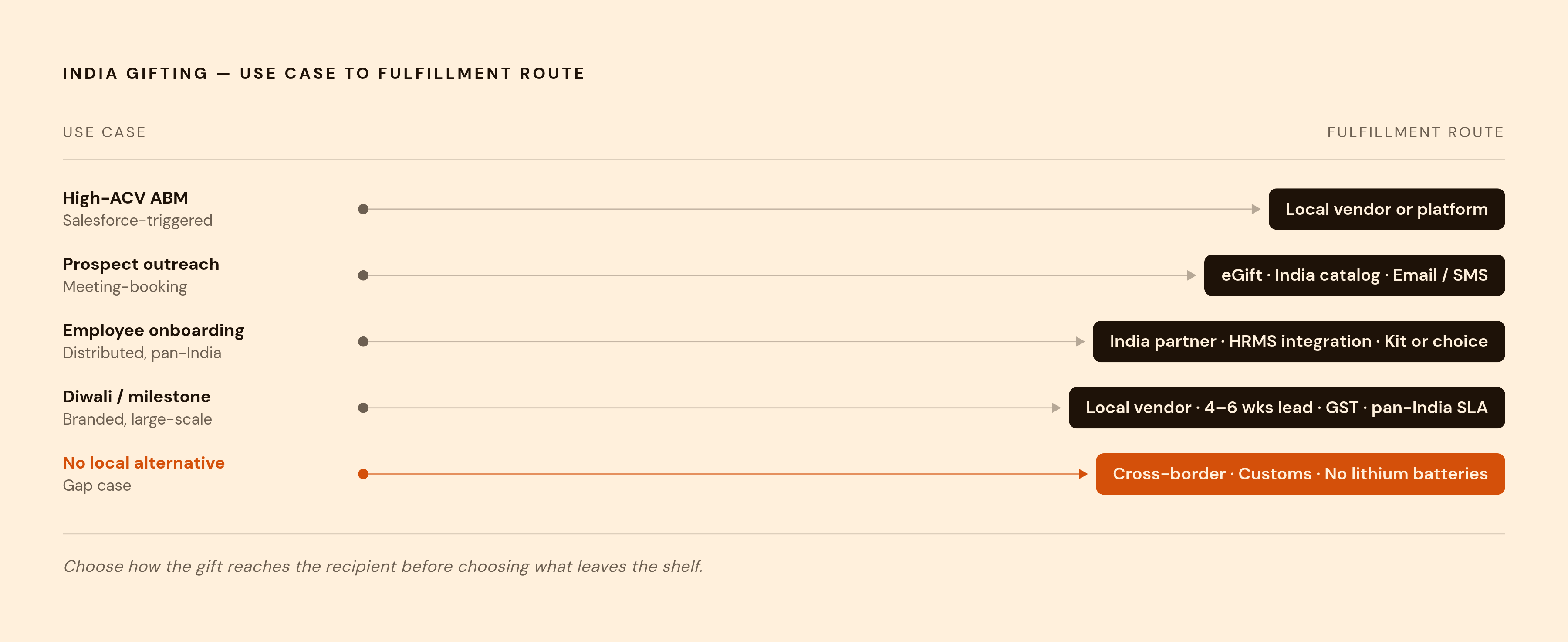
The decision starts with the program’s constraints. Use case, recipient location, volume, deadline, physical or digital preference, and integration requirements determine the fit. A handful of executive recipients is different from hundreds of employees, just as a planned campaign differs from a same-day follow-up.
For high-ACV ABM sends that need to arrive on time, a physical send triggered from Salesforce and handled by a local vendor or platform is a good fit. For broad prospect outreach and meeting-booking incentives, an eGift from a local India catalog can arrive by email or SMS without address collection. Speed favors digital in that second case. For distributed onboarding, the fit is an India-based partner with the relevant HRMS integration and kit or choice capability, or a platform with India fulfillment.
For large Diwali or milestone campaigns with branded packaging, the appropriate route is a local vendor engaged 4–6 weeks ahead, with GST invoicing and a pan-India delivery SLA. Cross-border physical shipping belongs only where locally sourced alternatives are genuinely unavailable. That route needs allowance for customs clearance, avoidance of lithium battery items, and verification of declared value treatment. The organizing principle is simple but consequential. Choose how the gift will reach the recipient before choosing what leaves the shelf.